
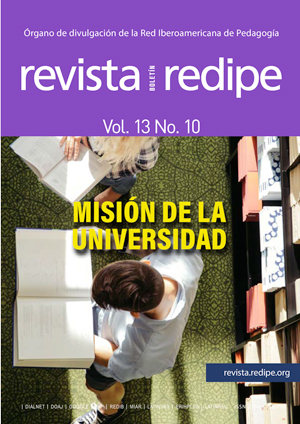
Mission of the university
Main Article Content
Keywords
University, Profession, Teaching and education, Ethics, Criticism, Change
Abstract
The author describes the situation that the Spanish university is going through, which can be extrapolated, to a large extent, to the Latin American university. The author limits his work to answering the following questions: a) what is happening in Western society; b) what university do we have; c) what university do we need; and d) what should we do? The author argues in favour of ‘another kind of teaching’ that introduces ethics at the heart of university learning, which, in addition to preparing good professionals, favours the training of responsible citizens at the service of the common good. This is based on two lines of action: a) a new concept of man as a historical, circumstantial being. The human being that we know from experience is not a universal, abstract idea; it is the being that makes the context or circumstance its natural habitat, and b) man as a relational being, open to others and responsible for them. It is the other who makes us human. Responsibility thus becomes the core of any education or training in citizenship.
References
Bauman, Z. (2003) Modernidad líquida (México, FCE).
Chalier, C. (1995) Levinas. La utopía de lo humano (Barcelona, Riopiedras).
Duch, Ll. (2004) Estaciones del laberinto (Barcelona, Herder).
Horkheimer, M. y Th. W. Adorno (1994) Dialéctica de la Ilustración (Madrid, Trtotta).
Levinas, E. (1993) Entre nosotros (Valencia, Pre-Textos).
Levinas, E. (2011) De otro modo que ser o más allá de la esencia (Salamanca, Sígueme).
Levinas, E. (2015) Ética e infinito (Madrid, Machado Libros).
Lipovetsky, G. (2000) La era del vacío: Ensayos sobre el individualismo contemporáneo (Barcelona, Anagrama) 13ª edic.
Maiso, J. (2016) Sobre la producción y reproducción social de la frialdad, en J. A. Zamora; R. Mate y J. Maiso (eds.) Las víctimas como precio necesario (Madrid, Trotta).
Mate, R. (2011) Tratado de la injusticia (Barcelona, Ánthropos).
Mate, R. (2018) El tiempo, tribunal de la historia (Madrid, Trotta).
Mêlich, J. C. (2010) Ética de la compasión (Barcelona, Herder).
Mêlich, J. C. (2021) La fragilidad del mundo (Barcelona, Tusquets).
Ortega y Gasset, J. (2015) Misión de la Universidad (Madrid, Cátedra).
Ortega, P. (2004) La educación moral como pedagogía de la alteridad, Revista Española de Pedagogía, 227, pp. 5-30.
Ortega, P. (2012) Una universidad para nuestro tiempo, Edetania, 42, pp. pp. 53-74.
Ortega, P. y Romero, E. (2019) A la intemperie. Conversaciones desde la pedagogía de la alteridad (Barcelona, Octaedro).
Ortega, P. y Romero, E. (2023) La acogida en educación a partir de Levinas, en R. Mínguez y L. Linares (coords.) La pedagogía de la alteridad. Un compromiso ético con otro modo de educar (Barcelona, Octaedro).
Ortega, P. (2024a) El “otro” en la antropología de E. Levinas, Revista Redipe, 13, 1, pp. 21-34.
Ortega, P. (2024b) El “otro” en la ética de E. Levinas. Implicaciones para la educación, Revista Redipe, 13, 3, pp. 23-38.
Ortega, P. (2024c) Circunstancia y responsabilidad en el proceso educativo, en P. Ortega Ruiz, La huella del otro (Colombia, Red Iberoamericana de Pedagogía), pp. 130-146.
Pintor-Ramos, A. (2011) Introducción a la edición castellana, en Emmanuel Levinas De otro modo que ser o más allá de la esencia (Salamanca, Sígueme), pp. 11- 39.
Ricoeur, P. (1969) Finitud y culpabilidad (Madrid, Taurus).
Rosenzweig, F. (2005) El Nuevo Pensamiento (Buenos Aires, Adriana Hidalgo edit.).
Article Sidebar
Article Details

This work is licensed under a Creative Commons Attribution-NonCommercial-ShareAlike 4.0 International License.
Authors will keep their copyright and guarantee the journal the right of first publication of their work, which will be simultaneously subject to the Creative Commons Recognition License that allows third parties to share the work whenever its author is indicated and his first publication this magazine.

Revista Boletín Redipe by Red Iberoamericana de Pedagogía is licensed under a Creative Commons Attribution 4.0 International License.
Pedro Ortega Ruiz, University of Murcia, Spain
Director of the International Collective of Pedagogy of Otherness, REDIPE. Member of the REDIPE Quality Committee. Creator of the paradigm of pedagogical discourse and educational praxis Pedagogy of Otherness.
Retired professor of Educational Theory at the University of Murcia, director of the International Network of Pedagogy of Otherness (RIPAL, REDIPE). Retired from the University of Murcia.