
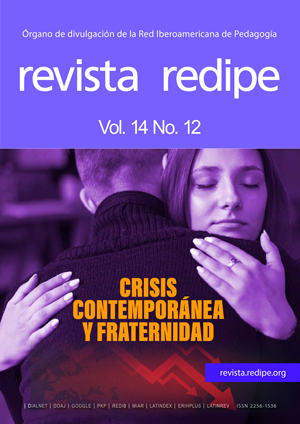
The fraternity in E. Levinas
Main Article Content
Keywords
Fraternity, Compassion, Anthropology, Ethics, Injustice
Abstract
The author approaches fraternity from Levinas’ perspective. For Levinas, fraternity is not an “added” quality to human behaviour that accredits him as a good citizen. It is his ‘natural condition’. Man is, by his ‘nature’, a compassionate, fraternal being. The whole reason for man’s being and existence is to be open to others; he is a being for others; transcending himself and opening himself to others is part of his nature. Levinas draws on the Hebrew Bible as a source for his thinking. The biblical texts present us with the man who welcomes the immigrant, who shares his bread with him and gives him shelter. He is the man who takes care of the stranger, the orphan and the widow. Finally, the author analyses the consequences of the morality of ‘duty fulfilled’, insensitive to situations of injustice, and defends an ethic that arises from the experience of suffering, not from a judgement of reason about “good” and ‘evil’.
References
Adorno, Th. W. (2004) Minima Moralia (Madrid, Akal).
Bello, G. (2006) El valor de los otros. Más allá de la violencia intercultural (Madrid, Biblioteca Nueva).
Chalier, C. (1995) Levinas. La utopía de lo humano (Madrid, Riopiedras).
Dussel, E. (2001) La ética. Congreso del educador social. Barcelona. 6-9 de junio de 2001 (Barcelona, CASC).
González-Arnáiz, G. (2021) Ética y responsabilidad (Madrid, Tecnos).
Habermas, J. (1991)Escritos sobre moralidad y eticidad (Barcelona, Paidós)
Horkheimer, M. y Adorno, Th. W. (1994) Dialéctica de la Ilustración (Madrid, Trotta). Levinas, E. (1993) Entre nosotros (Valencia, Pre-Textos).
Levinas, E. (2011) De otro modo que ser o más allá de la esencia (Salamanca, Sígueme).
Levinas, E. (2015) Ética e infinito (Madrid, Machadolibros).
Levinas, E. (2014) Alteridad y trascendencia (Madrid, Arenalibros).
Levinas, E. (2004) Difícil libertad (Madrid, Caparrós).
Levinas, E. (2002) Totalidad e infinito (Salamanca, Sígueme).
Levinas, E. (1974) Humanismo del otro hombre (Madrid, Siglo XXI).
Mate, R. (2011) Tratado de la injusticia (Barcelona, Anthropos).
Mate, R. (2018) El tiempo, tribunal de la historia (Madrid, Trotta).
Mêlich, C. (2010) Ética de la compasión (Barcelona, Herder).
Mêlich, J. C. (2021) La fragilidad del mundo (Barcelona, Tusquets).
Miller, A. (2017) Levinas. Ethics or Mystification, Journal olf Philosophy of Education, 51 , 2, pp. 524-537.
Montero, J. L. (2025) ¿Arqueología bíblica o arqueología y biblia? Un viejo debate a la luz del siglo XXI, Reseña Bíblica, 127, pp. 12-21.
Montero, C. (2019) La compasión: diálogo con M. Nussbaum y E. Levinas, Pensamiento, 75, 285, pp. 947-961.
Ortega, P. (2016) La ética de la compasión en la pedagogía de la alteridad, Revista Española de Pedagogía, 264, pp. 243-
Ortega, P. y Romero, E. (2019) A la intemperie. Conversaciones desde la pedagogía de la alteridad (Barcelona, Octaedro).
Ortega, P. (2025a) Pedagogía de la alteridad: Levinas y la educación (Murcia, Editum-Redipe).
Ortega, P. (2025b) La substitución en Levinas y sus implicaciones en la educación Redipe, 14, 11, pp. 25-44.
Papa Francisco (2020) Fratelli Tutti (Roma, Editrice Vaticana).
Pintado, O. (2024) Emmanuel Levinas. Pensar lo impensable (Madrid, Ciudad Nueva).
Pintor-Ramos, A. (2011) Introducción a la edición castellana. En. Emmanuel Levinas De otro modo que ser o más allá de la esencia (Salamanca, Sígueme), pp. 11-39.
Taylor, Ch. (1996) Fuentes del yo (Barcelona, Paidós).
Urabayen, J. (2005) Las raíces del humanismo de Levinas:El judaísmo y la fenomenología (Universidad de Navar
Zambrano, M. (2019) Levinas y el otro (Madrid, Apeiron).
Article Sidebar
Article Details

This work is licensed under a Creative Commons Attribution-NonCommercial-ShareAlike 4.0 International License.
Authors will keep their copyright and guarantee the journal the right of first publication of their work, which will be simultaneously subject to the Creative Commons Recognition License that allows third parties to share the work whenever its author is indicated and his first publication this magazine.

Revista Boletín Redipe by Red Iberoamericana de Pedagogía is licensed under a Creative Commons Attribution 4.0 International License.
Pedro Ortega Ruiz, University Professor. Murcia, Spain
University Professor. Murcia, Spain